If you've ever served on an HOA board, you know the secret: most of the work isn't glamorous. It isn't strategic planning sessions or landscape committee debates. It's chasing down a dues payment from the household on Cedar Lane that's now 47 days late. It's resending the same announcement about the pool gate code because two residents missed the group email. It's flipping through a coffee-stained spreadsheet to remember which address Joel and Maria actually live at.
If you're considering joining your HOA board — or you're a property manager looking at a portfolio of communities — this is the day-to-day reality that most board members never talk about until they're in the middle of it.
This guide breaks down what an HOA actually does, the five core jobs every board takes on, and why the tools most communities use to run themselves — spreadsheets, group texts, paper notices, and personal email — are quietly making the work harder than it has to be.
What an HOA actually is (in plain English)
A Homeowners Association is a private organization that residents of a planned community automatically join when they buy their home. The HOA collects monthly or annual dues from each household, uses those dues to maintain shared amenities and common areas, and enforces a set of rules — sometimes called CC&Rs (Covenants, Conditions, and Restrictions) — that all residents agreed to when they moved in.
There are around 370,000 HOAs in the United States, governing roughly 27% of the U.S. population. If you live in a planned subdivision built since the 1980s, there's a good chance you're in one whether you think about it daily or not.
The HOA's authority comes from a deed-recorded set of governing documents. These documents define what the HOA can charge, what it must maintain, what rules residents must follow, and how the board itself is elected and operated. In small communities the board is made up entirely of resident volunteers. In larger ones, the board may hire a professional property management company to handle the operational work.
The five jobs every HOA board has to do
Whether your HOA has 12 units or 1,200, the work breaks down into the same five categories. How well each one is handled is what separates the communities people brag about from the ones they vent about on Nextdoor.
1. Collect dues and manage the budget
Dues are the lifeblood of an HOA. They fund landscaping, snow removal, pool maintenance, insurance on common buildings, reserves for capital projects (roofs, parking lots, retention ponds), and any contracted services the community pays for.
The annoying part isn't budgeting — it's collection. Every HOA has the same conversation about the same handful of delinquent households every quarter. Reminders go out via paper notices that get tossed unread, late fees accrue, the treasurer ends up making awkward phone calls, and eventually somebody has to file a lien. Even communities with a great auto-pay rate still have 10-15% of residents who require manual chasing.
2. Communicate with residents
The single most-cited complaint from HOA residents in survey after survey isn't dues, isn't rules — it's communication. Residents say they didn't know about the road closure, the assessment increase, the change to pool hours, the meeting they would have attended.
Boards usually communicate through some combination of paper notices left on doors, group email blasts that half the audience never opens, a private Facebook group only 60% of residents joined, and word of mouth. Every channel reaches a different subset of the community, and nobody hears the same things at the same time.
3. Maintain a current resident directory
Knowing who actually lives where sounds trivial until you need to do it well. Households turn over. Renters come and go. Phone numbers change. A board member who's been on the board for three years has likely watched the directory spreadsheet drift from "mostly accurate" to "complete fiction" — and the only way to refresh it is to send another round of forms residents won't fill out.
A bad directory makes every other job harder. You can't reach the household with a leaky water main if their phone number is from two phones ago. You can't put names to the faces at the annual meeting. You can't even reliably tell a salesperson which units are owner-occupied versus rented.
4. Enforce rules and resolve disputes
Rules enforcement is the job nobody wants but every board ends up doing. Trash cans left out, parking violations, unapproved paint colors, the fence height someone exceeded by six inches. Some of it is genuinely important (fire safety, easements, structural changes that affect neighbors). Some of it is petty. All of it generates paperwork — letters sent, responses tracked, hearings held, decisions documented.
And boards have to do this fairly. If two households get warning letters for the same violation but one gets fined and the other doesn't, that's a lawsuit waiting to happen.
5. Run discussions, polls, and meetings
HOAs are tiny democracies. Annual meetings approve budgets and elect board members. Special meetings address big issues — assessments, by-law changes, contentious vendor decisions. Between meetings, boards take the community's temperature on smaller things: do we want to repaint the clubhouse this year, do we want to keep the gym open 24 hours, do we want to enforce the "no holiday lights past January 31" rule.
Getting honest, representative input is hard. Show up to a hot-button meeting and you hear from the loudest 8% of residents. Send a survey and you get a 12% response rate, skewed toward retirees and people with strong opinions. The quiet majority — the people who'd shape the community in better directions if they were heard — usually isn't.
Why the typical toolkit isn't working
Most HOAs are running these five jobs on a stack of tools that wasn't designed for any of them:
- A spreadsheet on someone's personal Google account for the resident directory and dues tracking.
- A shared inbox or the property manager's personal email for announcements.
- A group text thread for time-sensitive updates — that 40% of residents have muted because Cathy keeps sending GIFs.
- A paper mailing for anything official, costing $1.50 per household per send and reaching residents 5-7 days after it leaves the printer.
- A Facebook group for the residents who like Facebook, leaving everyone else out.
- A filing cabinet for governing documents, meeting minutes, and historical records — accessible only to whoever has the key.
Every one of these tools is doing something useful. The problem is that they don't talk to each other. The spreadsheet doesn't know who paid. The email doesn't know who received it. The Facebook group can't take an enforceable vote. The paper notice arrives the day after the deadline. And the institutional knowledge of how the community runs lives in a few people's heads — and walks out the door when those people sell their homes.
The board doesn't lack effort. It lacks a shared place where the work actually lives.
What changes when you put it on one platform
This is the problem NeighborTopia is built to solve. Every one of the five jobs above gets a dedicated workflow that connects to the others. Here's what each one looks like in practice.
Announcements that actually reach everyone
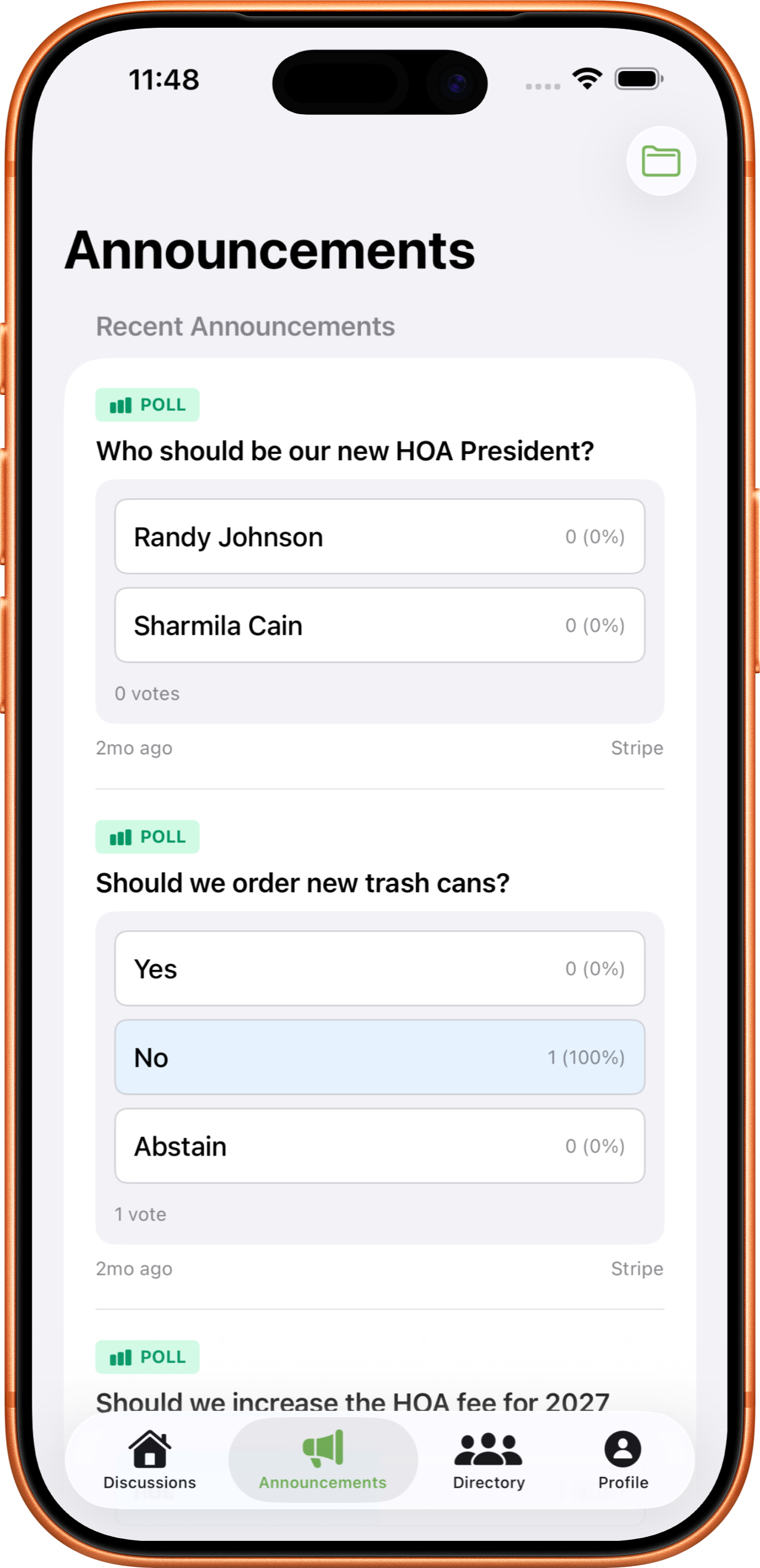
One announcement, posted once by a board member or property manager, lands in three places simultaneously: the resident's app, their email inbox, and (for time-sensitive ones) a push notification. Residents see the same message at the same time regardless of which channel they prefer. Polls are built into the announcement system, so you can attach a quick "yes/no/abstain" question without coordinating a separate survey tool.
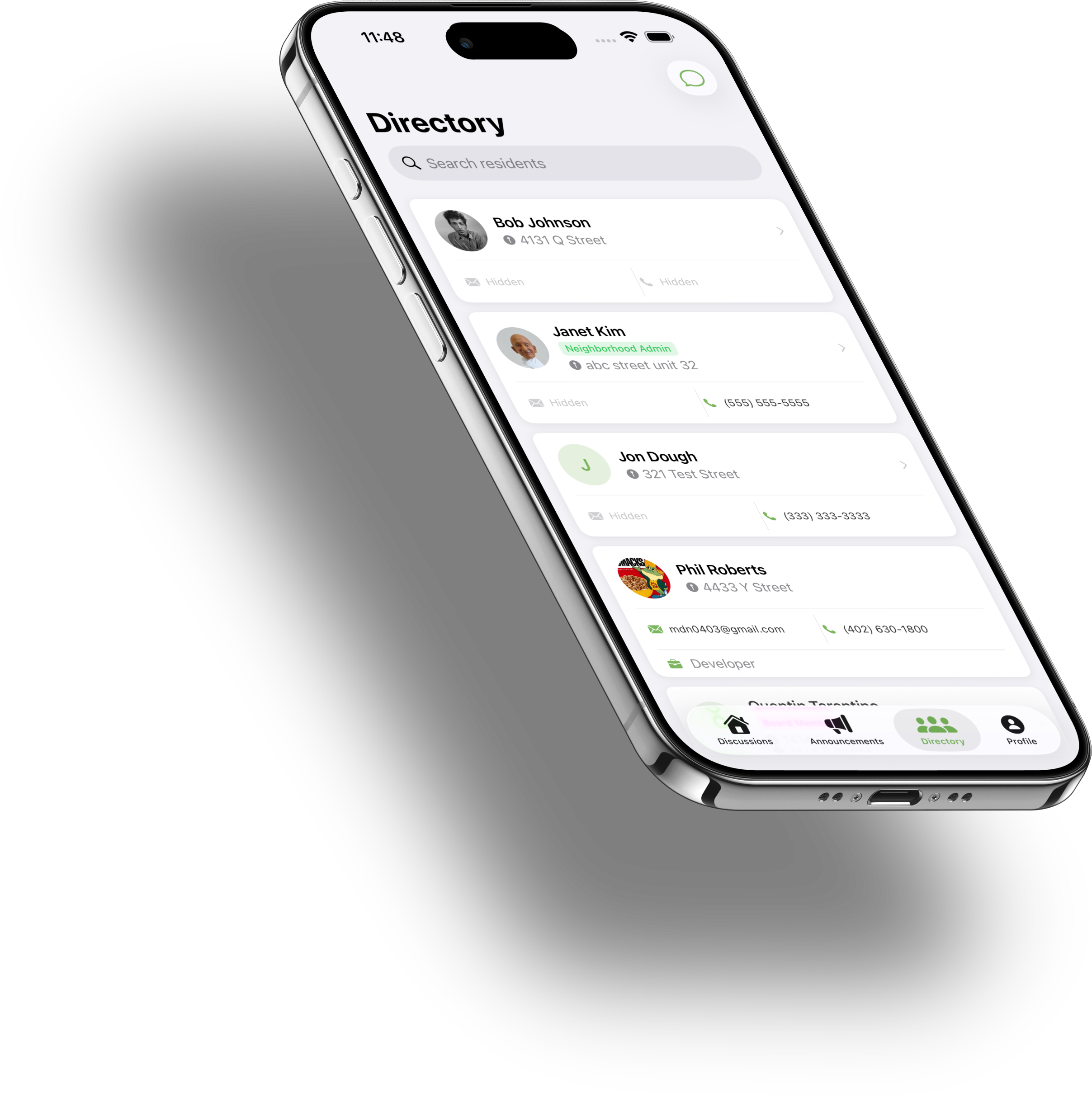
A resident directory that's actually current
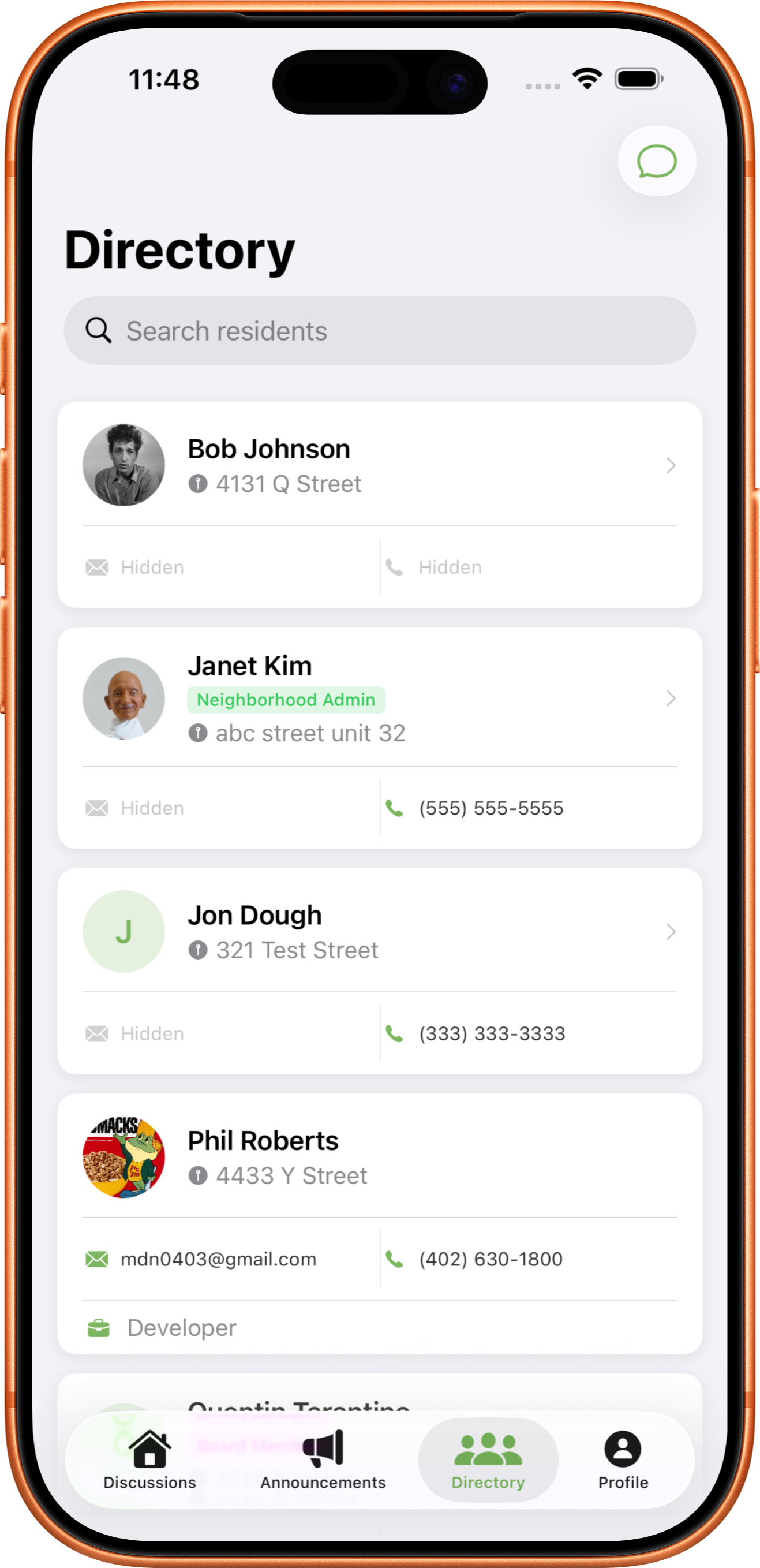
Instead of a board member maintaining the directory on behalf of everyone, residents manage their own entries. When somebody changes their phone number, it updates everywhere immediately. New owners get added through an invitation flow tied to the address; departing residents are removed cleanly. Privacy is controllable — residents choose what's visible to neighbors and what stays private.
Discussions and group chats that aren't on Facebook
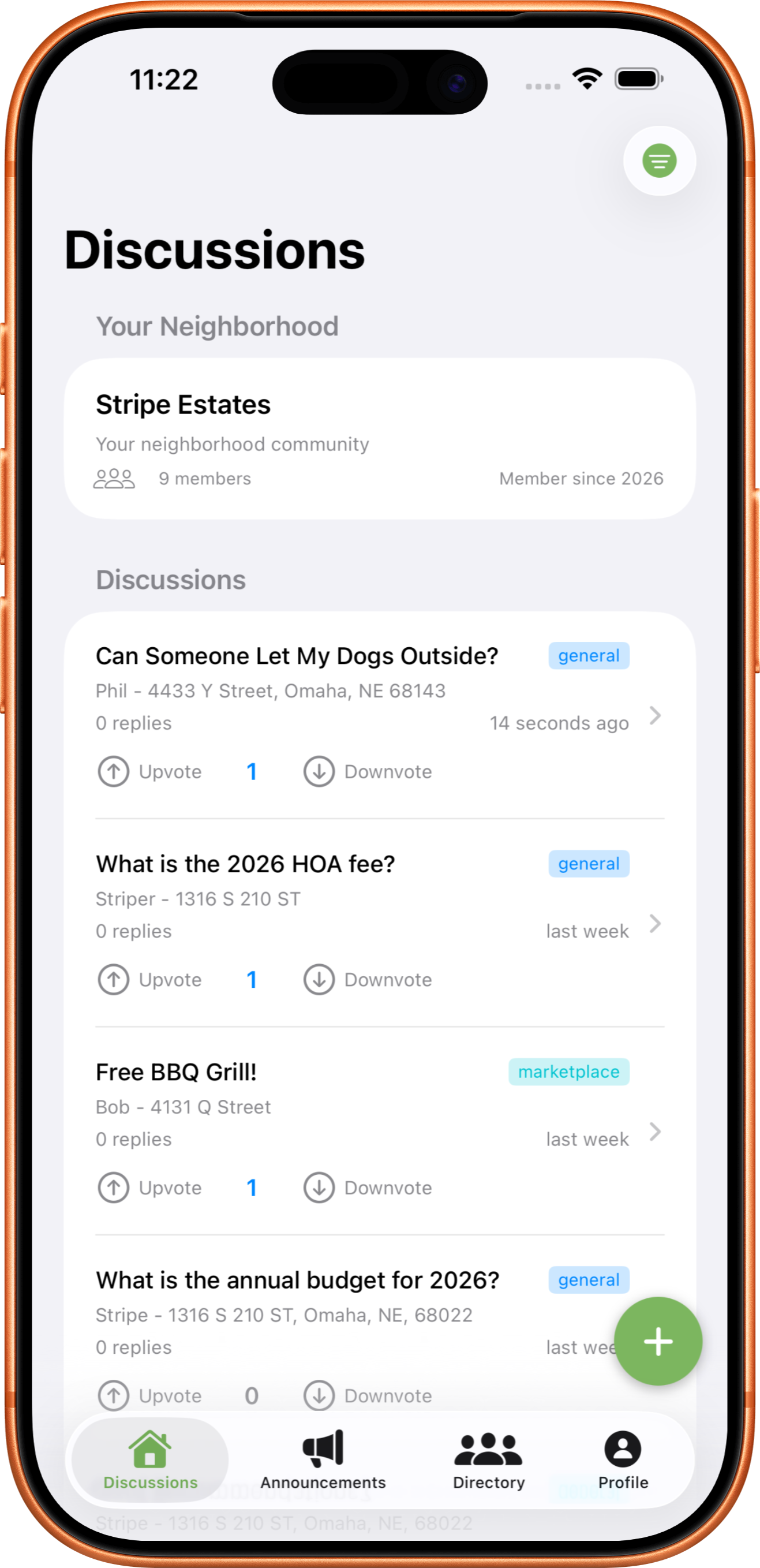
Residents can post questions, run a small marketplace (free items, recommendations, contractor referrals), and chat in groups — without dragging the community onto a public social network. Discussions stay searchable, threadable, and visible only to verified residents. The board can pin important conversations, archive resolved ones, and moderate when needed.
HOA payment tracking with automated reminders
Every household has a clear payment status — current, due, overdue. When a payment is late, the system sends automated reminder emails on a schedule the board defines. The treasurer goes from making 14 awkward phone calls to confirming the system already followed up. Payment history is recorded against the address, so future board members aren't piecing together history from email threads.
A single home for governing documents, meeting minutes, and shared resources
Bylaws, CC&Rs, meeting minutes, vendor contracts, the pool gate code, the snow plow schedule — all in one private library that every resident can search. The board's "where did we file that?" anxiety goes away. So does the new board member's first month of "I don't know how anything works around here."
What this actually frees up
HOAs aren't going to stop being HOAs. The work still has to happen — bills get paid, rules get enforced, residents get reached, decisions get made. But when the boring parts run themselves, two things change.
First, board volunteers stop quietly burning out. The reason boards struggle to fill seats isn't that nobody wants to help — it's that the people who tried last term told everyone how much of a slog it was. Cut the slog and the volunteer pool grows.
Second, the community gets a better community. Residents who feel heard show up. Neighbors who know each other's names look out for each other. Boards that aren't drowning in admin actually have time to plan — to think about the long-term capital project, the shared amenity people would love, the conversation worth having.
That's what we're building NeighborTopia for. Not to replace the people who care about their communities — to give them their nights and weekends back.
Try NeighborTopia free for 30 days
We'll onboard every household at no cost. Cancel anytime in the first 30 days — you won't be charged.
Start free trial See all features