Almost every HOA board secretary has the same recurring nightmare in early autumn: the annual meeting is coming. Will there be a quorum? Will the contentious topic on the agenda get out of hand? Will anybody actually show up who isn't already angry about something?
Annual meetings are required by your governing documents and by state law. They're where the board gets elected, the budget gets approved, and big decisions get formalized. But the experience of attending most HOA annual meetings is, frankly, terrible. Long, dull, dominated by a few loud voices, and ending with most attendees having no idea what was actually decided.
It doesn't have to be that way. The mechanics of running a good HOA meeting are well understood — they're just rarely applied. Here's how to design one that people leave feeling heard, informed, and (occasionally) even glad they came.
The four jobs of an annual meeting
Before agenda design, get clear on what an annual meeting actually has to accomplish. There are four legitimate purposes:
- Legal/procedural: Approve the prior year's minutes, present the financial report, hold elections, and ratify the new budget.
- Decision-making: Vote on any major issues that require member approval (assessments, by-law changes, vendor decisions over a certain threshold).
- Information sharing: Tell residents what's been done, what's coming, and what's not happening.
- Community building: Give neighbors a chance to be in the same room and remember they live near each other.
Anything that isn't serving one of those four jobs shouldn't be on the agenda. The reason meetings drag is that boards stuff them with reports, updates, and discussions that should have been written down and circulated in advance.
The agenda template that works
Here's a 60-minute agenda that hits all four jobs without padding:
- 5 min — Call to order, quorum confirmed. The chair confirms a quorum is present, reads the agenda, and starts the official record.
- 5 min — Approval of last year's minutes. Pre-distributed via email. Motion, second, vote. Move on.
- 10 min — Treasurer's report. Pre-distributed slides. Highlights only — three numbers (operating budget, reserve balance, delinquency rate). Questions, then vote to accept.
- 15 min — Board election. Candidate statements limited to 2 minutes each. Voting happens in parallel (paper ballots collected, or app-based vote opens). Move on while votes are counted.
- 15 min — Major decisions. One or two items max. For each: pre-distributed background, 3-minute board recommendation, 3 minutes pro/con discussion, vote. Don't open the floor for unstructured debate.
- 10 min — Open forum. Anything residents want to bring up. 2-minute time limit per speaker. The chair must be willing to enforce it.
Notice what's not on the list: committee reports, vendor updates, "state of the community" speeches. Those go in the pre-meeting packet residents receive a week in advance. The meeting itself is for decisions and dialogue, not narration.
Getting quorum (the part nobody warns you about)
Most state laws require a quorum to make decisions binding. Without one, you can hold the meeting but you can't approve anything. And quorum requirements are usually higher than people expect — 30-50% of members is typical.
Three tactics that move the needle:
Send proxies early and remind aggressively
Most members who don't attend in person are willing to sign a proxy. Send the proxy form 3 weeks before the meeting, send a reminder 2 weeks out, send another 1 week out, and have a board member or property manager personally follow up with the 5-10 households you historically don't hear from.
Make hybrid attendance real, not theoretical
Post-2020, most state HOA statutes now permit virtual or hybrid attendance for annual meetings. Use it. Letting members attend over Zoom or Google Meet typically doubles attendance — a meaningful chunk of your membership genuinely can't make a Tuesday 7pm meeting in person, and you've been losing their voices.
Critical: people attending virtually need to be able to vote. If your voting mechanism is paper ballots only, your hybrid attendance is fake. Use an app-based vote or at minimum collect virtual votes via email with proper documentation.
Make it shorter
If your meetings reliably run 2-3 hours, residents who attended once will not attend again. The 60-minute target above is non-negotiable. If you can't fit everything in 60 minutes, you have too much on the agenda — not too little time.
Handling the contentious topic
Every annual meeting has the hot-button issue. The proposed assessment. The pet policy change. The pool gate code rotation. The neighbor who's been complaining about the same thing for 18 months.
The mistake boards make is treating these like surprise topics to be wrestled with at the meeting. They're not surprises. You knew this was coming. So pre-empt the heat:
- Acknowledge it publicly before the meeting. In the pre-meeting packet, name the issue, summarize both sides fairly, and state where the board stands and why.
- Run a poll in advance. Send a single-question survey to all members 1 week before the meeting. The point isn't to make a binding decision — it's to surface where the room actually stands so the meeting isn't dominated by the loudest 5%. A current resident directory is what makes this possible.
- Structure the debate. At the meeting, allow 3 minutes for the board's position, 3 minutes total for opposing views, then vote. The chair has to be willing to interrupt when someone goes long.
The goal isn't to avoid the conversation. It's to make sure the conversation is informed, time-bounded, and decisive.
A meeting that ends with a clear decision is a successful meeting, even if some people disagreed with the decision. A meeting that ends with everyone exhausted and nothing resolved is a failure, even if everyone was polite.
What to do after the meeting
The annual meeting isn't really over when the chair adjourns. There are three follow-ups that matter:
- Send the minutes within 7 days. Not three months later. Memory is fresh, decisions are still relevant. Email the draft minutes, ask for corrections, finalize within 2 weeks.
- Send a one-page summary to non-attendees. The 30-50% of members who didn't attend deserve to know what was decided. Don't make them read the minutes — give them three bullets.
- Open a question thread. People who couldn't ask at the meeting will have questions later. Give them a place to ask without having to email the board secretary directly.
How software actually helps
Most of the annual-meeting friction described above is, fundamentally, a communication problem. Sending the agenda packet, collecting proxies, running pre-meeting polls, conducting hybrid voting, distributing minutes — every one of these is the same workflow: "send a document or question to every member, collect their response, report the outcome."
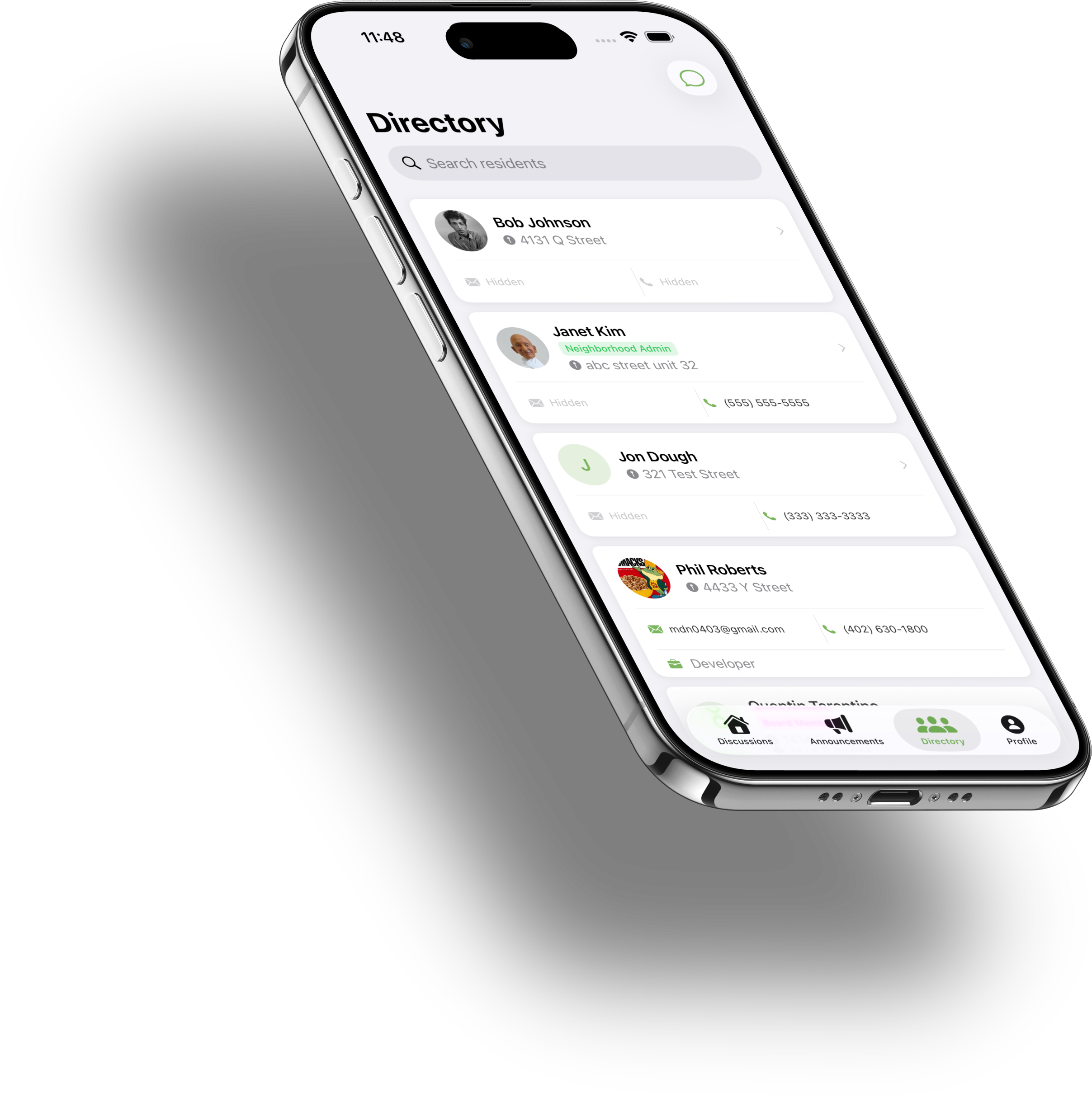
That's exactly what platforms like NeighborTopia are built for. Announcements with attached documents, polls with one-tap voting, a member directory that's actually current, and a discussion space for follow-up questions. The mechanics of a smooth annual meeting are 90% just having a single place where members and the board can communicate efficiently.
If your annual meeting feels like a 6-week chaos period followed by a 3-hour meeting, the answer isn't a more efficient meeting. It's a more efficient surrounding workflow.
Try NeighborTopia free for 30 days
We'll onboard every household at no cost. Cancel anytime in the first 30 days — you won't be charged.
Start free trial See all features