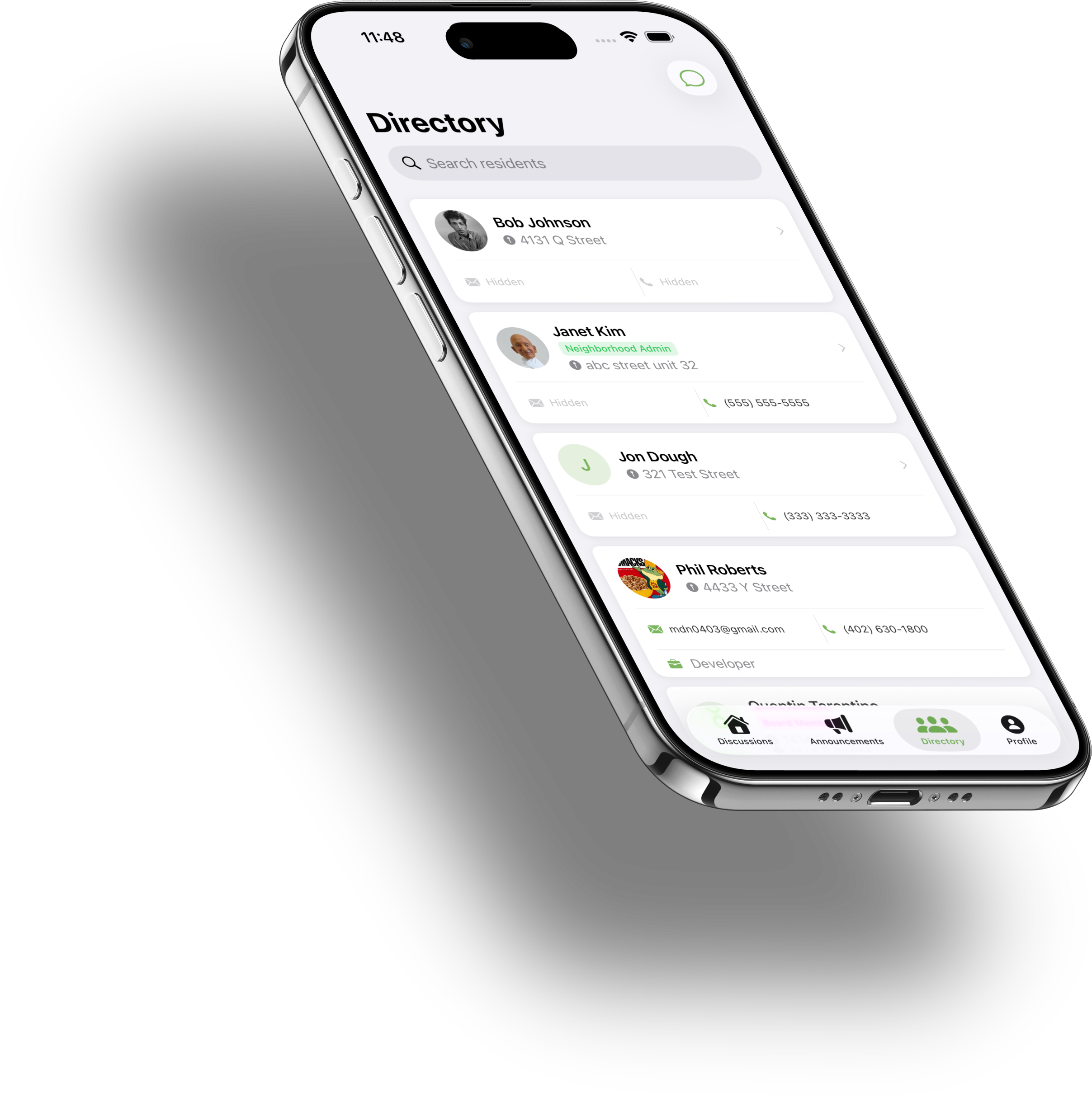
Almost every HOA tries to maintain a resident directory at some point. And almost every HOA's directory is, within 12 months of launch, useless.
Phone numbers go stale. Email addresses change. Residents sell their homes. Renters move in and out. The board member who was maintaining the spreadsheet gets tired and stops. And then a board member six months later goes "wait, who lives in unit 12?" and discovers the answer is a polite mystery.
The directory problem is real and it matters. A current directory is what makes the rest of HOA operations possible — sending the meeting notice, getting a quorum, reaching the household with a leaking water main, putting names to faces at community events. But the way most HOAs try to maintain one — a spreadsheet on the board secretary's computer — is doomed by design.
Here's how to set one up that actually stays accurate.
Why board-managed directories fail
Walk through the lifecycle of a typical HOA spreadsheet directory:
- The board secretary creates a Google Sheet with columns for name, phone, email, address.
- They send a form to every resident asking for their info. They get a 60% response rate.
- They populate what they have. The directory is now 60% complete.
- Three months later, somebody changes their phone number. They forget to email the secretary. The directory is now 60% complete and 5% wrong.
- Six months later, a household sells. New owners move in. The secretary doesn't find out for two months. The directory is now 55% complete, 7% wrong, and 3% phantom data.
- Eighteen months later, a new board takes over and inherits a spreadsheet that's so out of date they don't trust it. They send another form. Cycle repeats.
The fundamental flaw: the directory's owner (the board secretary) doesn't have firsthand knowledge of every change. The people who DO have firsthand knowledge (the residents themselves) have no incentive to keep the board's spreadsheet current.
Owner-managed directories outperform — every time
The fix is to flip the model. Instead of the board maintaining the directory on behalf of residents, residents maintain their own entries. The board's role shifts from data-entry clerk to system administrator.
This works because the incentives align. Residents WANT their info to be correct because they want to receive announcements, get their packages delivered, be reachable in emergencies. When they change their phone number, they update it once in their own profile and it propagates everywhere.
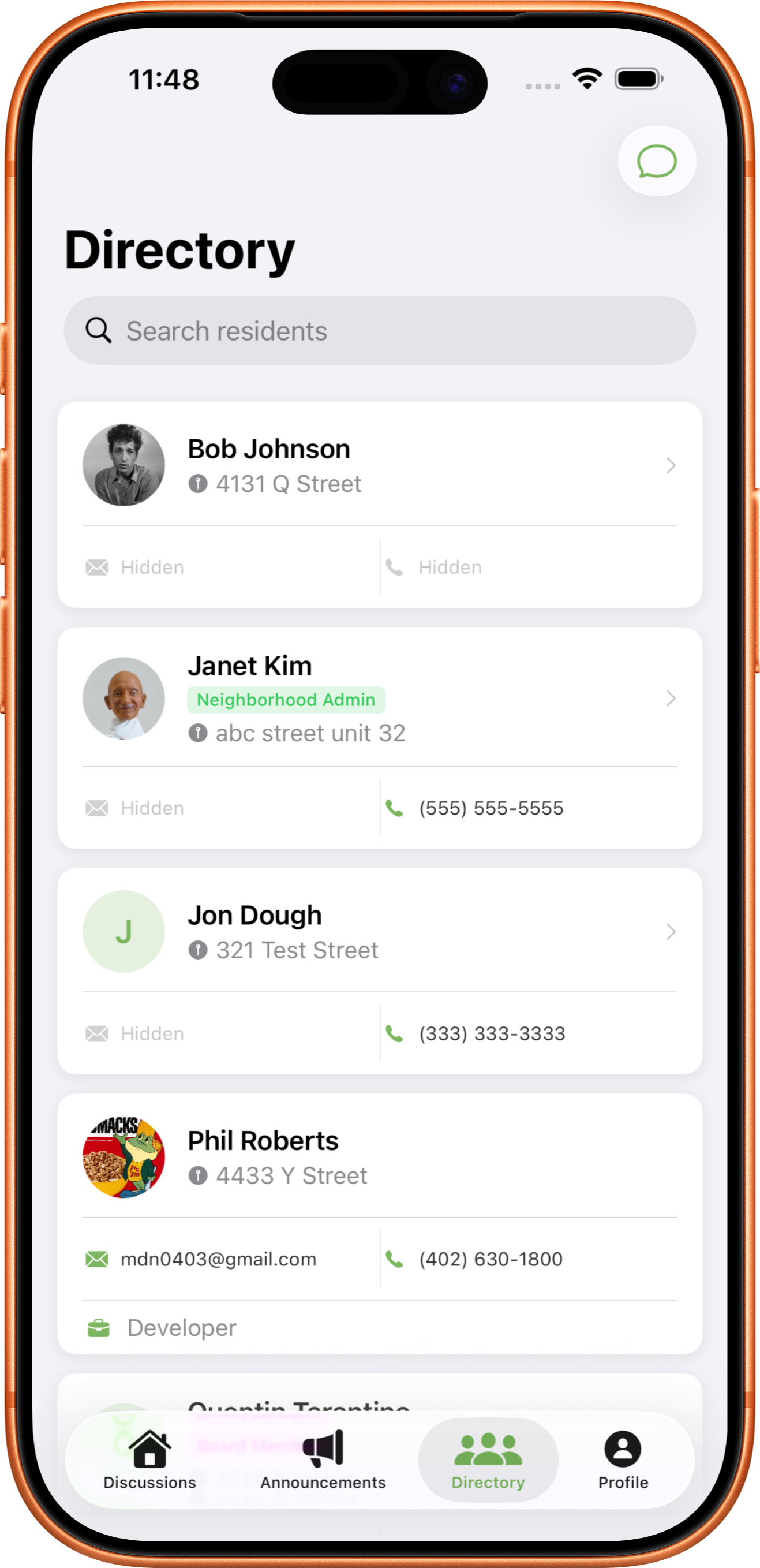
The data quality difference is dramatic. Board-managed directories typically run 40-60% accurate after 12 months. Owner-managed directories on a real platform run 90-95% accurate indefinitely, because each entry has someone whose job it is to keep that single entry correct.
What fields to actually capture
The temptation when designing a directory is to capture everything. Resist it. Each additional required field tanks the percentage of residents who'll complete their profile, and each additional optional field is one more thing that goes stale.
Here's the minimal viable set:
- Name(s). First and last for each adult resident. (Children, generally, don't need to be in the public directory — for safety reasons.)
- Address / unit. The household's address within the community.
- Email. Primary contact for digital communications.
- Phone. Optional, but useful for emergencies.
- Household role. Owner, renter, or property manager. This affects voting rights and who can receive certain communications.
- Move-in date. Used to identify new residents who might benefit from orientation outreach.
That's six fields. Anything beyond this is optional fluff that either won't get filled in or will go out of date.
Don't capture: date of birth, vehicle license plates, pet info, occupation, employer. These either create privacy risk, don't reliably stay current, or aren't actually used by anyone — and asking for them signals "we're collecting more than we need," which suppresses participation.
Privacy controls residents expect
The directory needs to balance two real concerns: it should be a useful resource for connecting neighbors, but residents shouldn't feel surveilled. The way you balance this is by giving each resident explicit control over what's visible to whom.
A reasonable default setup:
- Name and address: Visible to all verified residents by default. (These are already public information for property owners anyway.)
- Email: Hidden by default. Each resident chooses whether to make it visible to neighbors. The board can always reach them for official communications regardless.
- Phone: Hidden by default. Same logic.
- Children's info: Never visible. (And ideally not collected.)
Also: nothing should be public-internet visible. A "directory" that Google can index is a recipe for residents being identified by phishers, scammers, and stalkers. The directory should live behind authentication, accessible only to other verified residents of the same community.
Keeping it current — the four prompts that work
Even with owner-managed directories, you'll want gentle prompts to nudge residents to verify their info periodically. Four moments where prompts work:
- At sign-up. Welcome them, walk them through completing their profile, set their privacy preferences.
- Annual reminder. Once a year, a single "is your info still current?" prompt with a one-click "yes, still good" button. Don't make them fill out the form again.
- On address change. If somebody updates their household address (move to a different unit, name change after marriage), prompt them to also review their other info.
- Move-out detection. If a resident hasn't logged in or interacted with the app in 90 days, that's a signal something may have changed. Friendly outreach: "still in the community? Let us know."
What about new residents who haven't joined yet?
The biggest gap in any directory is the resident who hasn't enrolled. This is where the property manager or board can help — when a unit sells, send the new owner an invitation immediately. Don't wait until they show up at a meeting and you realize they're not in the system.
Some platforms (including NeighborTopia) handle this with address-based invitation codes that work BEFORE someone is in the system, so the moment they move in there's a one-step path to joining.
The best resident directory is one where the data is owned by the people who care most about it being correct — the residents themselves.
The compounding benefits
A current directory isn't an isolated win. It's the foundation for everything else. Once you have it:
- Official notices reach the right people in a legally defensible way.
- Quorum-building for annual meetings stops being a wild guess.
- Emergency outreach (water main break, road closure) actually reaches everyone.
- New-board onboarding takes hours instead of weeks.
- Conversion of in-person community to online discussion has a place to land.
The directory is invisible infrastructure. Nobody throws a party because the directory is current. But every workflow in your HOA quietly depends on it.
Try NeighborTopia free for 30 days
We'll onboard every household at no cost. Cancel anytime in the first 30 days — you won't be charged.
Start free trial See all features