Most HOA boards reviewing the annual budget can list every line item by heart. Landscaping. Insurance. Pool service. Snow removal. Reserve contributions. The big-ticket items.
What boards rarely add up — because they're not on a single line of any budget — are the smaller expenses scattered across "office supplies," "postage," "printing," and especially "we won't bother to count this." Individually each one looks negligible. Stacked across a year, they're often a meaningful chunk of the operating budget. For a 100-unit HOA, somewhere between $3,000 and $7,000 per year is typical.
If your board has ever wondered why the budget feels tight even though dues went up last year, the answer is usually here — in the costs nobody's tracking. Let's walk through where they actually live.
The visible-but-overlooked costs
Mailings and printing
This is the line item most boards underestimate by 50% or more. Let's run the math on a single quarterly announcement to a 100-unit community:
- Paper, envelopes, ink: roughly $0.20 per household
- USPS First Class postage (2026): $0.73 per piece
- Folding, stuffing, mailing labor: $0.15-0.25 per piece if outsourced, "free" if a board volunteer does it (but see below)
Total per piece: $1.10-1.20, or $110-120 per quarterly mailing. Send four times a year, plus annual meeting notices, plus assessment-change notices, plus the occasional emergency communication, and you're looking at $700-1,000 a year in paper communication for a small HOA. Bigger communities scale linearly: a 300-unit HOA crosses $2,500-3,000 just on these mailings.
Printed directory books
The annual directory — bound, color-printed, distributed to every household — is one of the more expensive single items in many HOAs. A 50-page softcover directory printed for a 100-unit community runs $6-12 per copy. Print 80 copies (one per household plus a few spares) and you've spent $480-960 on a document that's outdated by the time it's printed, because three households turned over during the print run.
Many communities have already abandoned this — but the ones that haven't are spending real money on it.
Meeting overhead
The annual meeting and quarterly board meetings have hidden costs that don't always make it into the budget:
- Meeting space rental if you don't have your own clubhouse: $150-400 per meeting
- Coffee and refreshments to encourage attendance: $50-100
- Printed packets (agenda, minutes, financial reports): $1.50-3.00 per attendee
- Mailed proxies for absent members: see above
For a community running one annual and four board meetings per year, that's $500-1,500 in meeting overhead alone.
Late-dues collection costs
This one's more variable but still real. Each late payment that requires manual follow-up — letter, follow-up email, phone call from the treasurer — has a real cost in postage, printing, and sometimes service-fee remittance to a collections vendor. A community with chronic late-payment issues can spend $400-1,000 a year just on the friction of collection — none of which actually recovers the late dues, just the cost of asking for them.
(For the workflow side of fixing this, see our piece on HOA dues collection.)
The invisible cost: volunteer time
The biggest cost line on most HOA budgets isn't on the budget at all. It's the time donated by board members, and it has a real economic value even when it's unpaid.
A reasonable estimate: a board secretary, treasurer, and president in a small HOA collectively donate 5-15 hours per week to community business. At a market opportunity cost of $40-60 per hour for the skills they're applying (financial management, dispute resolution, vendor management, communication), that's $10,000-45,000 of annual labor the community is consuming.
Boards don't pay this directly. But when a treasurer burns out and quits early, the community pays in two other ways: the recruiting cost of finding the next one (sometimes by hiring a property manager at $3,000-8,000/month to cover gaps), and the dropped-ball cost of things that don't get done in the transition.
This is why the "real" cost of inefficient HOA operations isn't the printing line item. It's the slow attrition of the volunteer pool and the costlier services you eventually have to buy when nobody will take the role.
What a community platform actually replaces
Walking through the same cost categories, here's what changes when communication moves to a platform like NeighborTopia:
Announcements go digital — postage and printing go to zero
One post on the platform delivers the same announcement to every resident's app, every resident's email inbox, and (optionally) a push notification — at zero per-message cost. The 4-6 mailings per year that cost $700-1,000 collectively become $0. The annual meeting notice that used to be a printed letter is now a one-click broadcast that residents acknowledge with a read receipt.
And reach goes up, not down. A digital announcement reaches 90%+ of residents (most check email and the app). A paper notice reaches maybe 60% (some residents never open mail addressed to "Resident" or "the homeowner at...").
The directory updates itself
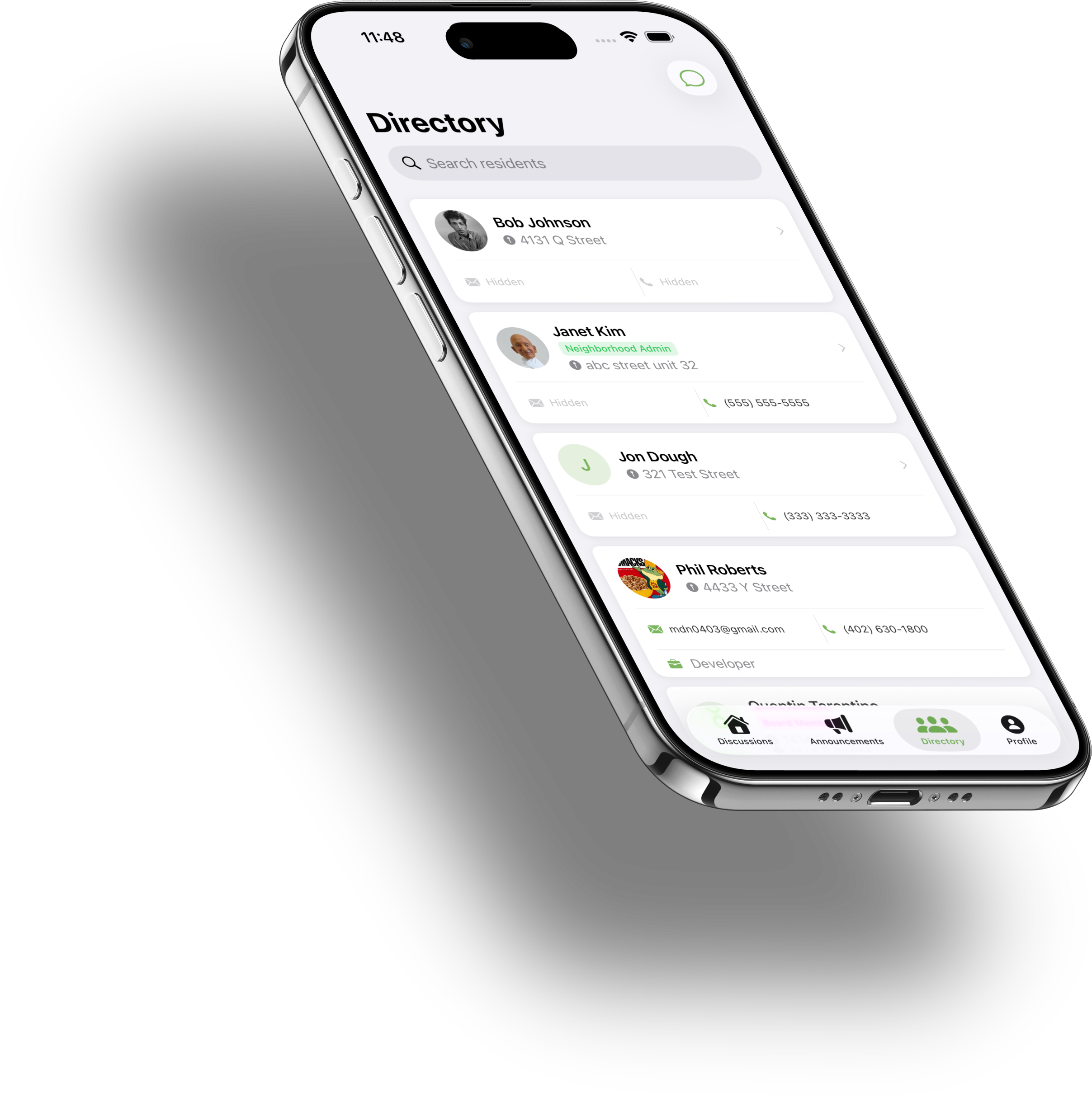
The printed directory's biggest problem isn't its cost — it's that it's wrong by the time it's printed. Residents update their own profile in the app whenever their phone number, email, or vehicle changes. The directory is searchable from any phone, always current, always private to verified residents.
(More on why this matters in our resident directory guide.)
Savings: $480-960/year per print run, plus 20-40 hours of volunteer time per year spent "collecting updates for the directory."
Meetings get cheaper to run
Pre-distributed agenda packets via the app eliminate the printing for in-person attendees. Hybrid attendance (residents joining via video) reduces the room-rental and refreshment scale-up. Polls and votes can be conducted in the app, eliminating paper ballots and the time to count them.
Annual meeting overhead drops by an estimated 50-70%.
Dues collection runs itself
Automated reminders for late dues — sent on a schedule the board defines — eliminate most of the manual follow-up. Residents see their own current balance in the app and can pay in two clicks. The treasurer's hours per quarter spent chasing late payments drops from 6-10 to under 1.
The biggest one — volunteer time
The single biggest "savings" isn't a budget line. It's that volunteer roles become sustainable. When the secretary's job is "log in and click a button" instead of "manage spreadsheets, print directories, fold mailings, chase signatures," people are willing to volunteer again. The community avoids the expensive replacement of "hire a property manager because we can't fill seats" path.
Adding it up
Here's a realistic annual savings estimate for a typical 100-unit HOA that switches from paper-and-spreadsheets to a community platform:
- Postage and printing for announcements: $700-1,000/year saved
- Directory printing: $400-900/year saved (if you were printing)
- Meeting overhead: $300-700/year saved
- Dues-collection overhead: $300-600/year saved (plus a meaningful drop in actual delinquency rate)
- Volunteer time: 100-200 hours/year recovered (call it $4,000-10,000 in opportunity cost)
Direct out-of-pocket savings: $1,700-3,200 per year. Recovered volunteer time, valued at market opportunity cost: another $4,000-10,000.
NeighborTopia's pricing for a 100-unit community runs well under $1,500/year. The math, even using only the direct out-of-pocket savings and ignoring all the volunteer time, is favorable.
Most HOAs don't have a cost problem. They have an accounting problem — the costs that hurt the most don't show up on the budget the board reviews.
The non-financial wins
The financial case is the easy one to make. But the operational improvements often matter more:
- Announcements actually reach residents. Your reach goes from ~60% to ~90%, which means complaints about "we didn't know about that" drop dramatically.
- The directory stays accurate. Board members aren't piecing together "who lives in unit 14B" from coffee-stained spreadsheets.
- Volunteers stay longer. Easier roles mean less burnout, which means fewer search-and-recruit cycles for the next treasurer.
- Records are defensible. When something legal comes up (and it does), having a system-of-record beats reconstructing from memory.
- Residents engage more. A platform that's actually useful gets used; engagement on community decisions goes up.
A simple test
If you're not sure whether the math works for your community, here's a 10-minute exercise that'll tell you. Pull last year's actual operating budget and add up:
- Total spent on postage
- Total spent on printing and copies
- Total spent on office supplies that are really communication-related (paper, envelopes, ink)
- Any property-management fees that include communication as a service
- An estimate of board-member hours spent on communication and recordkeeping (conservative: 5 hours/week × 50 weeks × 3 board members = 750 hours)
Multiply line 5 by $40/hour to put a number on it. Add the other lines. That total is what your community is currently paying for communication and recordkeeping. Compare to what a platform would cost. The conversation gets easy quickly.
Try NeighborTopia free for 30 days
We'll onboard every household at no cost. Cancel anytime in the first 30 days — you won't be charged.
Start free trial See all features