The hurricane is 48 hours out. The wildfire is moving north of the highway. The water main broke at 3am and most of the community is without water.
How does the HOA reach residents? How do residents reach each other? How does the board confirm everyone evacuated safely? Who's the point person if utilities need to coordinate with someone in the community?
Most communities answer these questions ad-hoc when the event happens. The communities that fare best have figured them out in advance.
Why this matters more than people think
When a real disaster hits, the regular communication infrastructure often degrades:
- Cell towers lose power or get overloaded
- Internet may be down for days
- The property manager may not be reachable
- Board members may be evacuating themselves
- Resident contact info may be out of date
- Volunteer responders may not know who lives where
And the things that matter most happen in the first 6 hours: who's home, who needs help, who can be checked on, who has medical or mobility needs, where the keys to common amenities are if responders need access.
Five things every HOA should have
1. A current resident emergency contact list
Names, addresses, current phone numbers, out-of-area contact (relative or friend who can vouch for an evacuated resident). Vehicle info. Any disclosed medical or mobility needs that may matter in an evacuation.
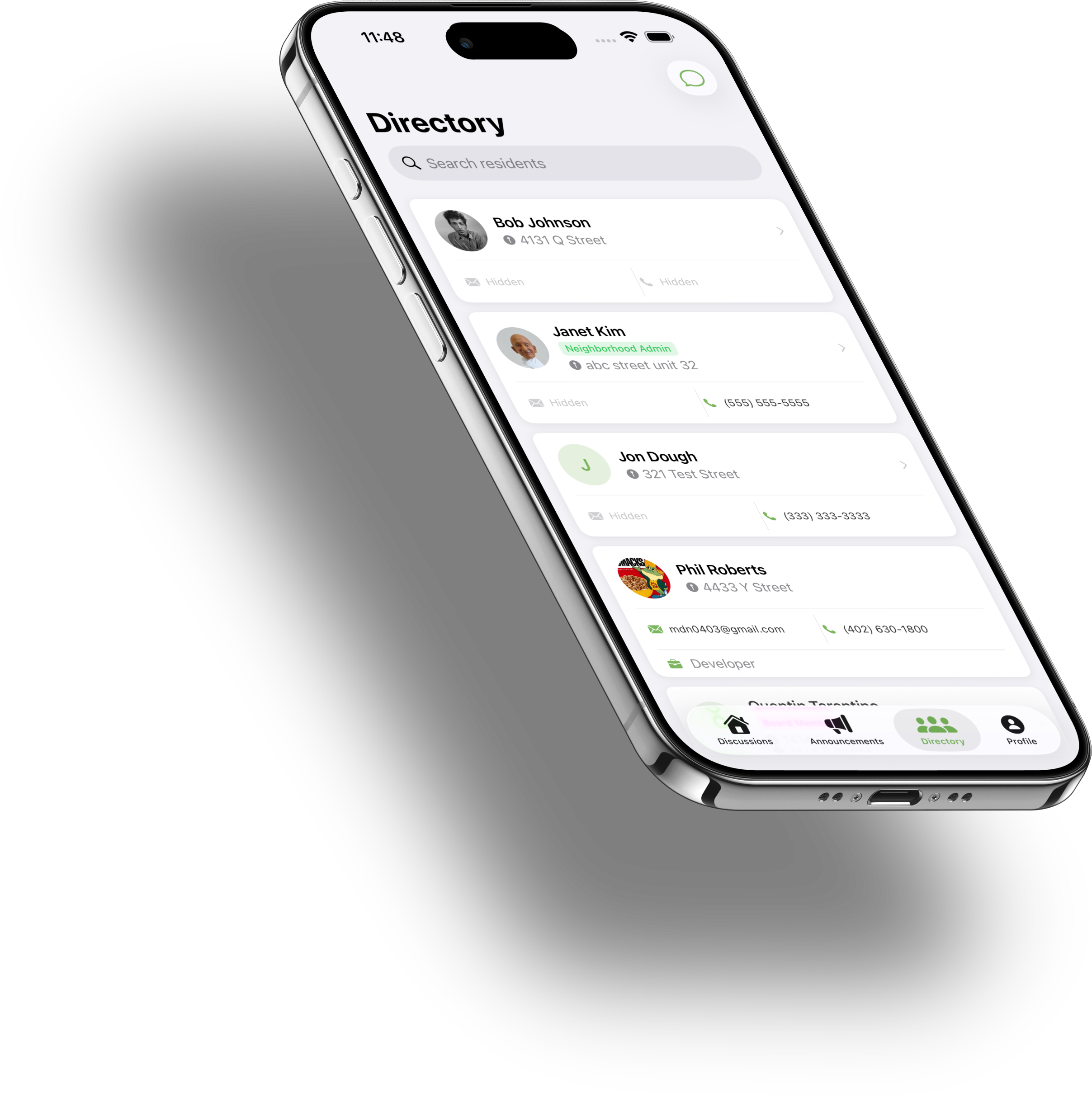
This is built on the foundation of a current resident directory. The information has to be opt-in for the disclosure that goes beyond basic contact, but most residents will share emergency info when asked.
It also has to be accessible somewhere other than the property manager's computer. A board member with offline access. Cloud-based access for the property manager from anywhere. Resident families who can confirm where their parent's emergency info is.
2. A multi-channel communication plan
Email alone is insufficient because it requires power and internet. The plan should include:
- App push notifications for the community platform (most likely to be seen on phones)
- SMS broadcasts for time-critical updates (often work when data doesn't)
- Email summaries for residents who prefer it
- Physical signage at entrances or amenity buildings for power-out scenarios
- Door-to-door check-ins by volunteers for elderly residents during widespread outages
3. A pre-defined incident command structure
Who's in charge of communication during a disaster? Who maintains the resident roll call (who's safe / evacuated / unaccounted)? Who interfaces with the property manager and outside utilities?
Without this, multiple board members independently start texting residents and the message gets garbled. With it, one person owns communication and others know to relay information to them.
4. Vendor and utility contact list
The water company, the electric company, the property manager, the landscape company (who may be needed for fallen-tree cleanup), the insurance company, the HOA attorney. Phone numbers, account numbers, after-hours contacts.
This list often only exists in the property manager's filing cabinet. It should exist in three places minimum: board president, secretary, and a cloud-accessible spot.
5. Mutual aid arrangements
Neighbors check on neighbors. Many communities have informal "block captains" or "neighborhood watch" structures that can be activated for disaster response. Knowing which residents have medical training, generators, or trucks helps mobilize quickly.
The communication patterns that work
Pre-event (event approaching, like an oncoming hurricane)
- Frequent updates — daily or twice daily as the event approaches
- Specific guidance — "the pool will be closed starting Friday at 6pm"; "garage doors should be reinforced"
- Confirmation requests — "reply to this message if you're evacuating so we know who's planning to stay"
- Resource sharing — sandbag locations, evacuation routes, generator rental sources
During the event
- Concise critical updates only — power-saving mode for everyone
- Roll-call check-ins — "if you're safe, reply YES"
- Single-channel coordination — pick one platform and stick to it
Recovery
- Damage reports — residents sharing what they see, board consolidating
- Resource coordination — generators, supplies, contractors
- Insurance guidance — claim filing, documentation requirements
- Repair contractor sourcing — many residents will need the same vendors; group discounts work
What community platforms enable
A modern community platform handles most of the communication infrastructure during disasters:
- One announcement reaches every resident across email, app, and (with the right config) SMS
- Roll-call check-ins can be done as a poll — residents respond with one tap, board sees the results in real time
- Vendor and utility contact info lives in the resources section
- Discussion threads allow residents to coordinate without each one calling the board
- Records of communication exist for insurance claims later
This is one of the situations where the difference between paper-based and platform-based community management becomes immediately visible.
Annual preparation cycle
Communities in disaster-prone areas should run an annual prep cycle:
- 30 days before hurricane / wildfire season: Update resident contact info, refresh emergency contact list, confirm incident command roles
- 15 days before: Send residents a "prep checklist" reminder, share community-specific guidance
- 5 days before season: Distribute the emergency communication channels — make sure everyone knows where to get updates
- During the off-season: Review what worked and what didn't from the prior year
This kind of preparation feels overkill until you need it. Then it's the most important thing the board did all year.
The communities that fare best in disasters aren't the ones with the most resources — they're the ones whose communication and coordination were already practiced before the event.
A note on legal exposure
Boards can be sued after disasters for inadequate communication. The defensive position is having documented evidence that the board took reasonable steps. Records of pre-event communication, roll-call check-ins, and post-event recovery coordination are valuable for both safety and legal-defense reasons.
This is yet another example of why communication discipline matters in HOAs. Disasters are exactly the wrong time to be reconstructing what was said when.
Try NeighborTopia free for 30 days
We'll onboard every household at no cost. Cancel anytime in the first 30 days — you won't be charged.
Start free trial See all features